
Armenia is known for being the first country to make Christianity its state religion and for a winemaking history that archaeologists trace back more than 6,000 years. It is also known for medieval monasteries built into cliffs and river gorges, for lavash flatbread and khorovats barbecue, and for the duduk, a double-reed instrument carved from apricot wood.
Visitors often mention something they did not expect: being invited into family homes for long lunches where they are treated as guests rather than customers. Below, we cover what Armenia is known for in each of these areas, from landmarks and food to music, the alphabet, and everyday customs.
Armenia adopted Christianity as its state religion in 301 AD, making it the first country in the world to do so. For travelers, this history is hard to miss. Armenia is slightly smaller than Maryland, yet it has an estimated 4,000 churches and monasteries, many of which were built between the 4th and 13th centuries. Most day trips from Yerevan include at least one.
The most important is Etchmiadzin Cathedral in Vagharshapat, about 12 miles west of Yerevan. It is the seat of the Armenian Apostolic Church and part of a UNESCO World Heritage site. Its original church dates to the early 4th century, which makes it one of the oldest cathedrals in the world.
This history explains much of what Armenia is known for. The monasteries, the carved stone crosses called khachkars, and even the alphabet all trace back to the church.
Most of Armenia’s famous landmarks are tied to its religious history. Four appear on almost every first trip: Khor Virap, Noravank, Geghard with the nearby Temple of Garni, and the Matenadaran manuscript library in Yerevan.
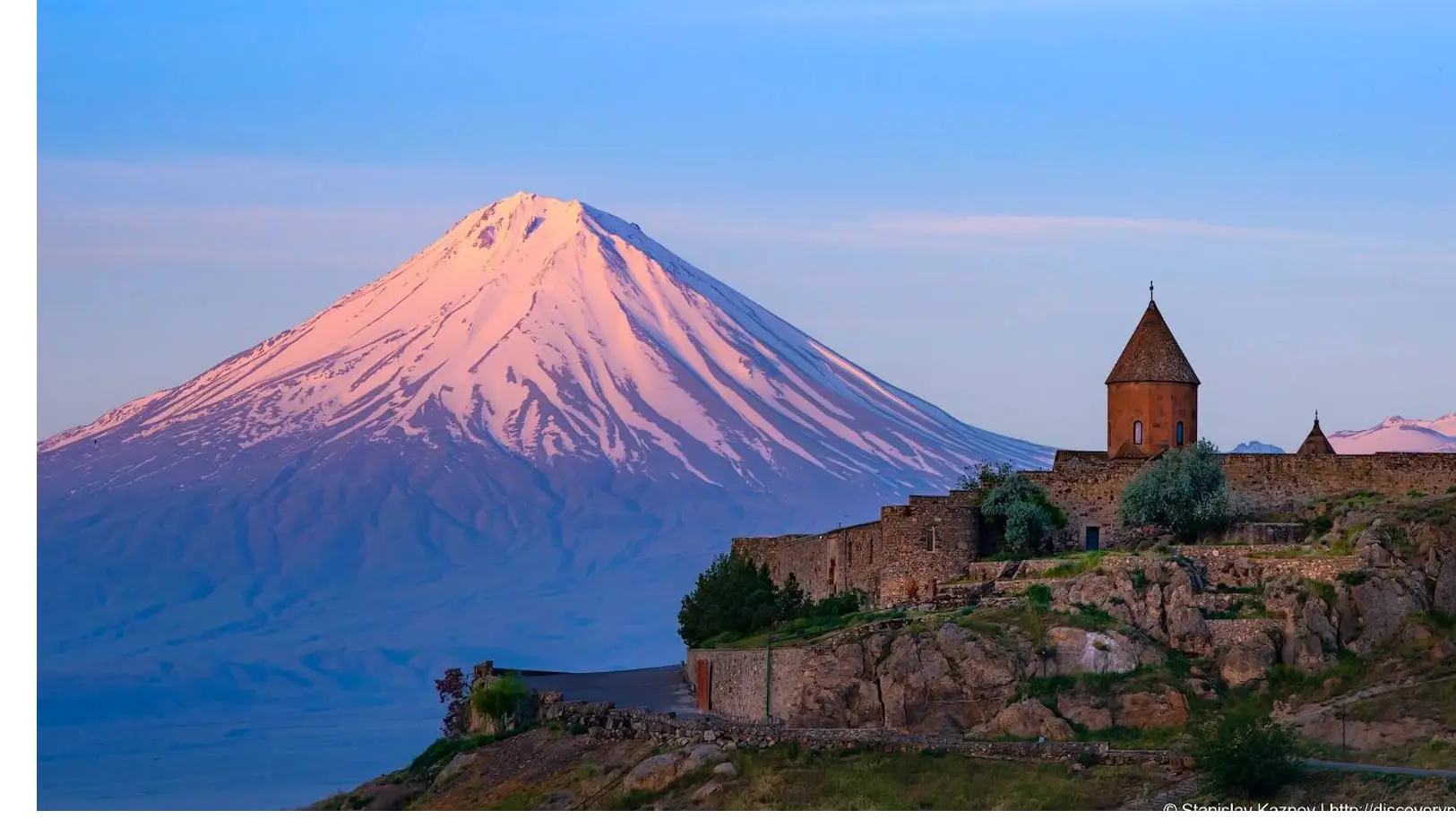
Khor Virap is a monastery about 30 miles south of Yerevan, best known for its view of Mount Ararat. Ararat is Armenia’s national symbol, but it stands across the border in Turkey, and the border has been closed since 1993. According to tradition, Gregory the Illuminator was held in a pit beneath the site for 13 years before converting King Tiridates III, an event that led to Armenia’s adoption of Christianity. Visitors can still climb down a steep ladder into the pit. On clear mornings, the monastery with Ararat behind it is one of the most photographed views in the country.
Noravank sits in a narrow gorge of red cliffs in Vayots Dzor province, about 75 miles southeast of Yerevan, and most of the complex dates to the 13th and 14th centuries. Its best-known building is the Church of Surb Astvatsatsin (Holy Mother of God), completed in 1339 by the architect and sculptor Momik.
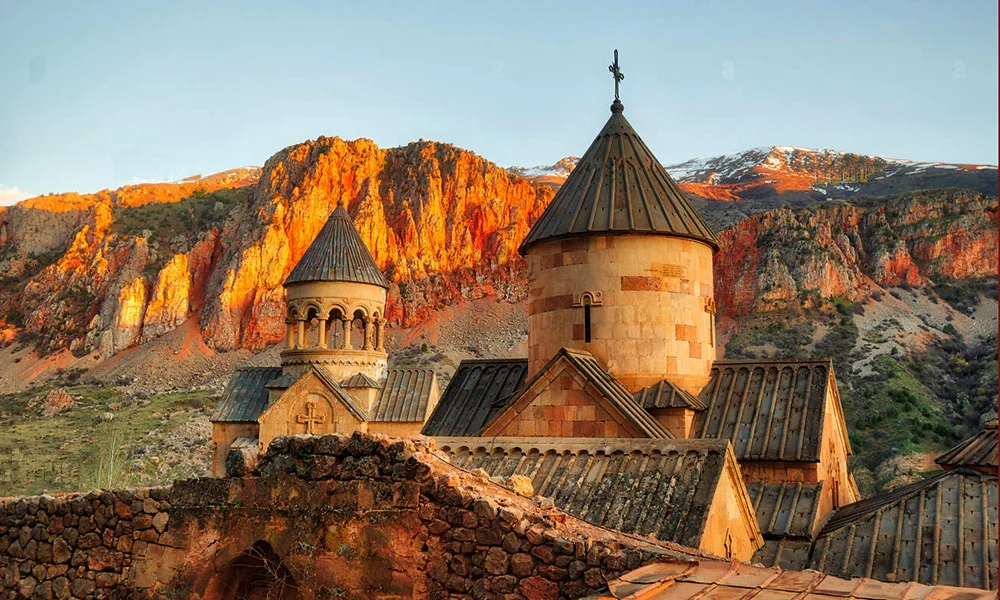
Two narrow stone staircases project from its front wall and lead up to a second-floor chapel, a layout rarely seen in Armenian church architecture. The steps are steep and lack railings, so many visitors take in the chapel from below. Noravank is also a short drive from Areni, the village at the center of Armenia’s wine history.
Geghard is a monastery partly carved into the cliffs of the Upper Azat Valley, about 25 miles east of Yerevan, and is listed as a UNESCO World Heritage site. Its name means “spear,” after the relic said to have pierced Christ, which was once kept here and is now displayed at Etchmiadzin.
The main church dates to 1215, while several chapels behind it were cut directly into the rock, and their acoustics are strong enough that visitors often sing inside to hear the effect. A few miles away, the Temple of Garni is the only standing Greco-Roman colonnaded building in the former Soviet Union, traditionally dated to the 1st century AD. It collapsed in an earthquake in 1679 and was rebuilt in the 1970s, largely from its original stones. Because the two sites are so close, they are almost always visited on the same day.
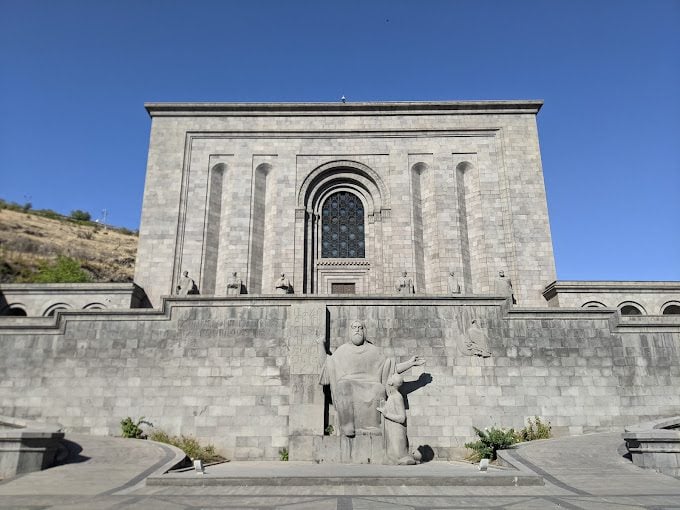
The Matenadaran in Yerevan houses nearly 23,000 manuscripts, one of the largest collections of medieval manuscripts in the world. They cover theology, history, medicine, astronomy, and philosophy, and include texts whose Greek or Syriac originals were lost and survive only in Armenian translation.
Many manuscripts were carried out of monasteries during invasions or returned from Armenian communities abroad, so the collection is also a record of the effort that went into saving them. Among its best-known items is the Lazarian Gospel, dated to 887. It is a good stop for travelers interested in Armenian history or the Armenian alphabet.
Armenia is known for lavash flatbread, khorovats barbecue, tolma, harissa, and fermented dairy like matsoon, as well as wine and brandy. Most meals are built around fresh bread, herbs, grilled meat, and produce from the country’s high valleys.
Lavash is a thin flatbread made from flour, water, and salt. The dough is stretched over an oval cushion and pressed onto the hot inner wall of a tonir, a clay oven set into the ground. It bakes in under a minute and, fresh from the oven, is soft and slightly chewy, with charred spots where it touched the clay.
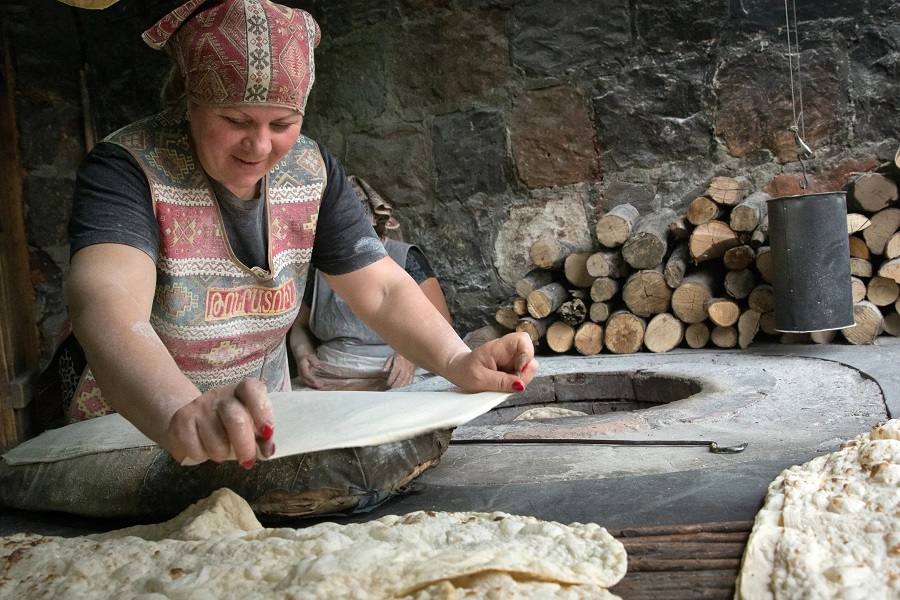
At the table, it is used to wrap cheese and herbs, to pick up pieces of grilled meat, or to be torn off and eaten on its own. UNESCO added lavash making to its Intangible Cultural Heritage list in 2014, and watching a small team of bakers work the tonir together is worth seeing if you get the chance.
Khorovats is Armenian barbecue: chunks of pork, lamb, or beef marinated with onion, salt, and black pepper, then grilled on skewers over grapevine-wood embers. Marinades vary by family, and some add wine or matsoon. Peppers, tomatoes, and eggplants are grilled alongside the meat, then peeled and chopped into a smoky salad. Khorovats is the centerpiece of birthdays, holidays, and Sunday gatherings, and most families have one person whose khorovats everyone agrees is the best.
Tolma is minced meat, rice, and herbs wrapped in grape or cabbage leaves, or stuffed into peppers, eggplants, and tomatoes. Versions exist across the region, but in Armenia, it is usually served with matsoon mixed with garlic. Harissa is a thick porridge of wheat and chicken or lamb, cooked for hours and stirred until smooth.
It is often called the national dish and is traditionally made in large pots to share. Matsoon, a fermented yogurt, also goes into soups like spas and into tan, a salted yogurt drink served with lunch. Most tables include a plate of fresh tarragon, purple basil, and cilantro, along with apricots, pomegranates, and walnuts grown in the highland valleys.
In the Areni-1 cave in Vayots Dzor, archaeologists found a wine press, fermentation jars, and grape seeds dated to about 6,100 years ago, the oldest known winery in the world. The local Areni Noir grape still makes most of Armenia’s best-known reds. Armenian brandy has its own reputation. The Yerevan Brandy Company, maker of the Ararat label, traces its history to 1887, and a popular story says Winston Churchill was one of its fans. Many tours include a tasting at a winery near Areni or at the brandy factory in Yerevan.

Beyond its churches and food, Armenia is known for the duduk, an instrument that has been in use for more than 1,600 years, and a custom of overflowing hospitality with guests closely tied to family honor.
The duduk is a double-reed woodwind instrument carved from apricot wood, and in Armenian it is also called tsiranapogh, or “apricot pipe.” Its sound is low, breathy, and close to a human voice. It is usually played in pairs, with one musician holding a steady drone note while the other carries the melody.
You will hear it at weddings, funerals, and holiday gatherings, as well as in restaurants and on the streets of Yerevan. Film audiences know it too: duduk master Djivan Gasparyan played on Hans Zimmer’s score for Gladiator and on Peter Gabriel’s Passion, and UNESCO first recognized duduk music as Intangible Cultural Heritage in 2005.
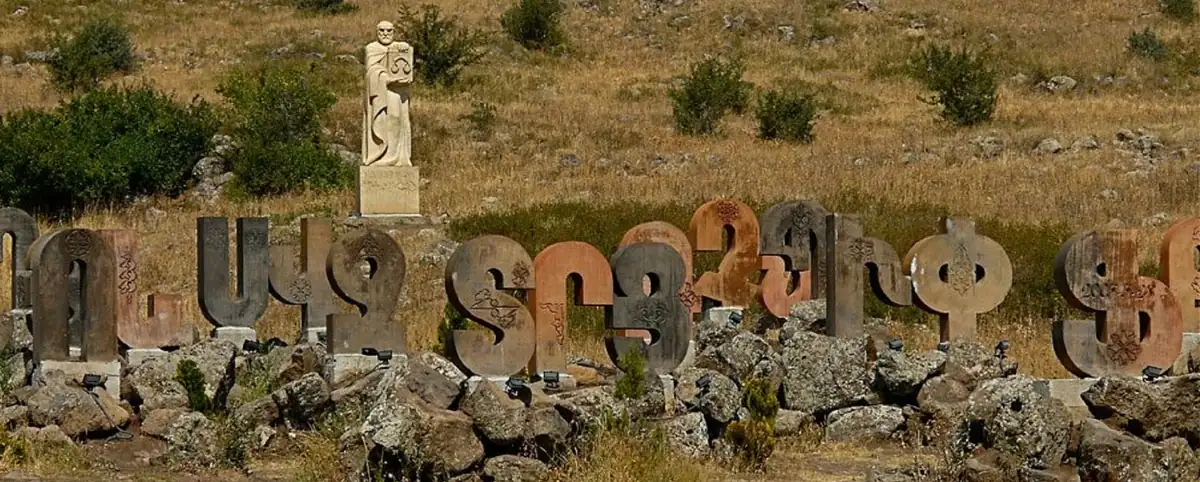
The Armenian alphabet was created in 405 AD by the monk Mesrop Mashtots so that the Bible could be translated into Armenian. It began with 36 letters, and two more were added in the Middle Ages; the same 38-letter script appears today on street signs, menus, and phone screens. Through centuries of Persian, Byzantine, Ottoman, and Russian rule, the alphabet remained something Armenians everywhere shared, and the church still honors Mashtots as a saint. Many of the oldest texts written in it are kept at the Matenadaran. North of Yerevan, near the village of Artashavan, large stone carvings of each letter stand on a hillside, an easy stop on the road toward Aparan.
In Armenia, feeding a guest well is a point of family pride: visitors are seated first, served first, and offered more until they have refused several times. A family lunch often runs two hours or longer, with homemade cheese, fresh herbs, bread, and a few toasts with oghi, a homemade fruit vodka. For Cascade Travel guests, these lunches are among the experiences most frequently mentioned in reviews. The families are not performing for tourists; they are cooking the same food they would make for relatives.
Armenia rewards travelers who give it more than a few days, because much of what Armenia is known for only makes full sense in person. A monastery means more once a guide explains who built it and why, and a glass of Areni Noir makes more sense in the valley where the grape has grown for thousands of years. Some of the most memorable places are not monasteries at all, like the prehistoric standing stones of Zorats Karer near Sisian or the restored 19th-century streets of old Dilijan.
Cascade Travel’s Armenia tours are planned around this kind of access: family lunches, wine tastings, and local guides who know the country well. For travelers who want to see Armenia and Georgia on the same trip, Cascade Travel’s Caucasus tours combine both countries with local support throughout.
Facts show that Armenia was the first Christian nation and is home to the world’s oldest known winery. They can’t tell you what it’s like to hear voices echo through Geghard’s rock-cut chapels, or to be handed a third piece of lavash at a family table before you’ve finished the second. That part you have to experience in person.