

The road from Yerevan to Tbilisi runs about 270 kilometers north, through Armenia’s Lori or Tavush region to the Georgian border. The drive takes 5 to 8 hours in total, including the border crossing, depending on the route and the vehicle. The journey from Tbilisi to Yerevan follows the same road in reverse, with the same options and timings.
There are four practical ways to make the trip: by train, by shared minibus, by private transfer, or by a guided tour that includes the crossing. This guide covers each one with realistic travel times and current prices. It also explains what happens at the Armenia-Georgia border and how long the crossing usually takes.

Yerevan and Tbilisi are about 270 kilometers apart by road. The drive itself takes 4 to 5 hours, and the border crossing usually adds 1 to 3 hours. Total journey times are:
The border wait is the one part nobody can predict, so avoid booking anything time-sensitive for the evening you arrive.
On the road between Yerevan and Tbilisi, you go through passport control twice at the Armenia-Georgia border: once to leave one country and once to enter the other. For most visitors, the paperwork takes minutes, and the queue decides how long you spend there.
Most travelers cross at Bagratashen on the Armenian side and Sadakhlo on the Georgian side, about an hour’s drive south of Tbilisi on the main highway. Minibuses and most private cars use this crossing. Armenia and Azerbaijan have no open border, so travelers visiting all three countries must cross here as well, which is why our Caucasus tours run from Baku through Georgia before entering Armenia.
The second option, Bavra and Ninotsminda, lies farther west and suits routes passing through Gyumri. It is quieter, but it sits on a high plateau where winter snow can slow the roads.
At a road crossing, passengers exit the vehicle and proceed on foot through Armenian passport control. The driver takes the vehicle through a separate lane. After a short neutral zone, you go through Georgian passport control and customs, and the driver meets you on the other side. Officers check passports, and bag searches are uncommon for tourists but possible.
On a quiet weekday, the full crossing takes 45 to 90 minutes. On weekends, public holidays, and during the summer peak, it can take 2 to 3 hours or more. There is no way to check the wait in advance, so allow 1 to 2 hours as a baseline.
You need a valid passport. Citizens of the US, UK, EU, Australia, and many other countries can enter these countries without a visa, in either direction. Requirements change, so check the current rules for your passport before you travel.
Planning a trip to Armenia and Georgia? Tell us your dates and interests, and our team in Yerevan will send you a route and price.Plan my trip
The Yerevan-Tbilisi train runs between Yerevan’s main railway station and Tbilisi Central Station. Under the winter timetable, which runs until mid-June 2027, it leaves every second day. Departure from Yerevan is at 9 pm, with arrival in Tbilisi at about 7 am. In the other direction, it departs Tbilisi at 8 pm and arrives in Yerevan at about 6:30 am. The summer timetable is published in June and usually moves the departure to the afternoon, so check the dates before planning around it.
There are no stops at the border. Armenian and Georgian officers board the train and check passports in each compartment. On the winter run from Yerevan, this happens between roughly 3 am and 5 am, so expect to be woken.
Tickets cost about €30 to €55 per person. The price depends on the class: an open-plan berth, a four-berth compartment, or a two-berth first-class compartment. Summer departures fill up, so book a few days ahead. There is no dining car, so bring food and water.
The train saves a night’s hotel cost, and in the summer you see the Debed Canyon in daylight. The trade-off is a narrow berth, shared toilets, and an interrupted night.
The Yerevan-Tbilisi bus is usually a shared minibus, known locally as a marshrutka, with 12 to 18 seats. In Yerevan, it leaves from the Kilikia bus station. In Tbilisi, it leaves from Avlabari, Ortachala, or Station Square, and minibuses from Yerevan arrive at one of the same three points.
This is the cheapest way to make the trip. The fare is about 8,000 AMD from Yerevan or around 50 GEL from Tbilisi, roughly €17 to €20, usually paid in cash to the driver. From Kilikia, departures run from early morning to around 5 pm. Some leave at set times, and others when the seats fill up, so arrive 30 minutes early.
Expect 5.5 to 8 hours door to door, including the border and one rest stop. At the border, everyone gets out and goes through passport control, and the minibus waits for the full group on the other side.
Seats are narrow, legroom is tight, and there is little space for large suitcases. Older vehicles may not have air conditioning. The ride is reliable, but you share it with up to 17 other people and have no say over stops.
A private car is the most comfortable way to make the trip on your own. It costs about €100 to €200 for the vehicle, depending on the car and the season. Sedans take up to four passengers with luggage, and a minivan for a larger group costs more. Split between four people, the price comes to about €25 to €50 each, a little more than the minibus for a lot more space.
The journey takes 5 to 8 hours door to door, including the border. The driver picks you up from your hotel and drops you at your next one, and you choose the departure time.
You still go through passport control on foot, as on the minibus. Stops on the way, such as Lake Sevan or Dilijan, can be added if you agree to them when booking, since they lengthen the day and may change the price.
Transfers can be booked through travel agencies in either city or through your hotel. Before you pay, confirm three things:
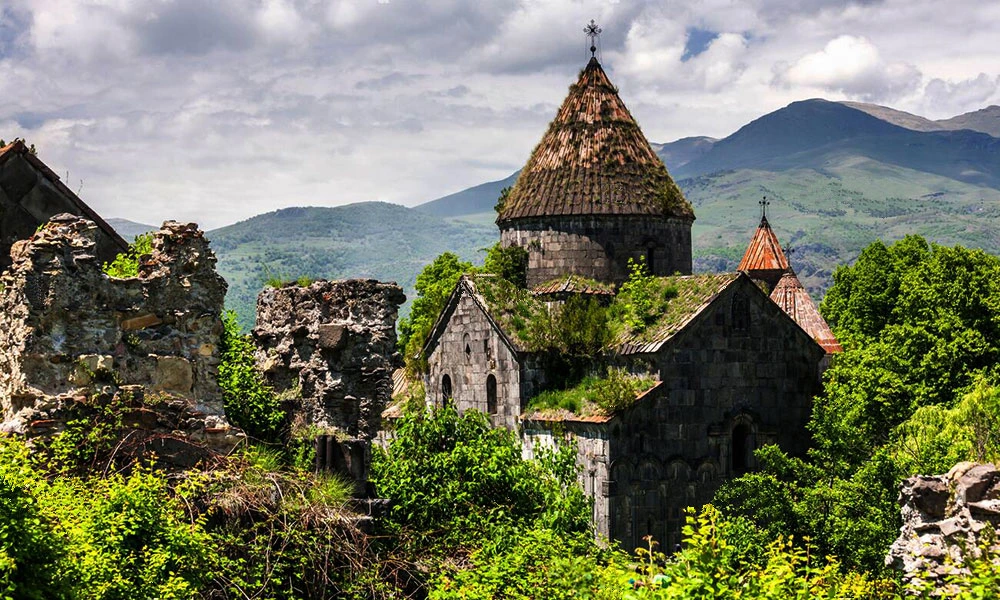
If you plan to visit both countries anyway, a guided tour makes the crossing part of the itinerary rather than a separate booking. On our trips to Georgia and Armenia, the transfer between the capitals is a full sightseeing day in a private, air-conditioned vehicle. The route runs through the Debed Canyon, with stops at Haghpat and Sanahin, two medieval monasteries less than an hour’s drive from the border. On the 17-day tour, the route crosses at Bavra instead, on the way to Gyumri.
At the border, your Armenian guide and driver hand over to a Georgian guide and driver, or vice versa. You still go through passport control on foot, but someone who knows the process is with you on one side and waiting on the other. There is no minibus to find, no fare to agree on, and no hotel transfer to arrange at either end.
This option suits travelers who want a guided trip through both countries. If you only need to get from one capital to the other, the first three options cost far less.
Yerevan to Tbilisi takes most of a day in either direction, and the border is the only part that needs patience. The train and minibus keep costs low, and a private transfer lets you set the timing.