
Georgia, the country in the South Caucasus, sits at the crossroads of Europe and Asia, bordered by Russia to the north, Turkey and Armenia to the south, and the Black Sea to the west.
For a country roughly the size of Ireland, it holds an unusual amount of contrast. There are Caucasus mountain ranges that rival the Alps, a winemaking tradition in the eastern valleys that runs back 8,000 years, a capital where medieval churches sit beside Soviet apartment blocks and glass towers, and a subtropical coastline on the Black Sea. The regions are distinct enough that moving between them feels less like traveling within one country and more like crossing several. That variety is also what makes narrowing down the best places to visit in the country of Georgia difficult: the right route depends on whether you want cities, wine regions, mountain landscapes, historic sites, or a mix of all four.
What follows is organized by region rather than ranked as a list, because the practical question when you plan a trip here is not which single site is best but which parts of the country you have time for and how they connect. Each section covers what the region is worth, how long to give it, and how it fits with the rest.
Almost every Georgia trip begins and ends in Tbilisi, and the city earns two to three days on its own.
The heart of it is Old Tbilisi, where carved wooden balconies hang over narrow streets, and the Abanotubani district still runs on the sulfur springs the city was founded on. The brick domes of the bathhouses sit half underground, and the baths themselves remain in daily use rather than preserved for visitors. Above the old town, Narikala Fortress gives you the view that makes sense of the city’s layout: the Mtkvari River cutting through, the old quarters on one bank, the newer city spreading behind.
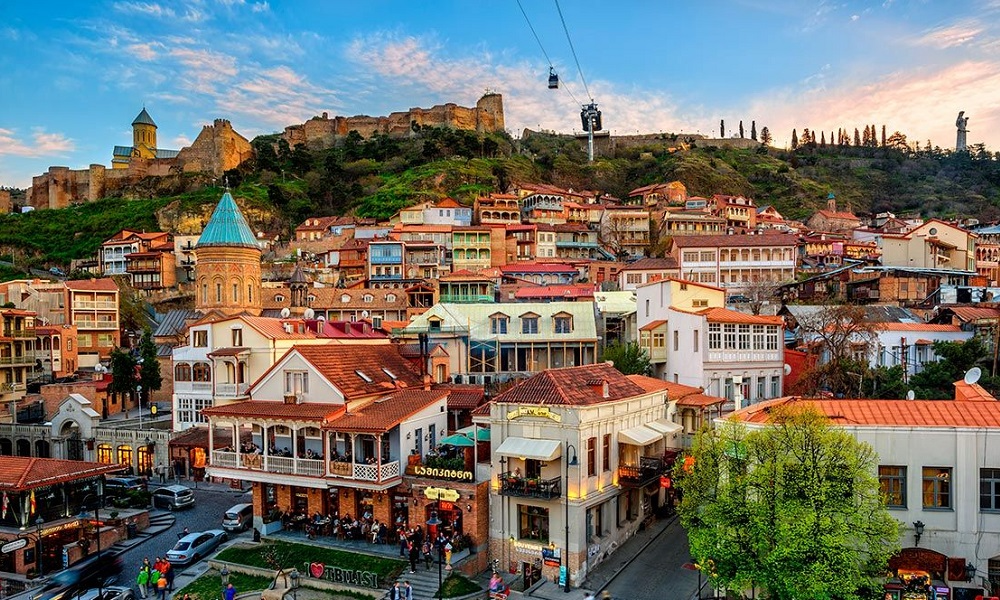
Sololaki and Vera are where you eat. This is a food and wine city, with everything from family-run supra restaurants to natural wine bars pouring qvevri wines from small Kakheti producers. If you are deciding what to do in the country of Georgia beyond visiting landmarks, Tbilisi is also a good introduction to the food, wine, bathhouse culture, and everyday city life that shape the rest of the trip.
Tbilisi is also the country’s logistics hub. Almost every region is reachable by road from here, which is why itineraries tend to radiate outwards rather than run in a loop.
Our classical Georgia tour is built around this layout, starting in Tbilisi before moving out to the regions.
Mtskheta lies twenty minutes north of Tbilisi and was the capital of Georgia for close to a thousand years before Tbilisi took the role. It remains the spiritual center of the Georgian Orthodox Church and a UNESCO World Heritage site.
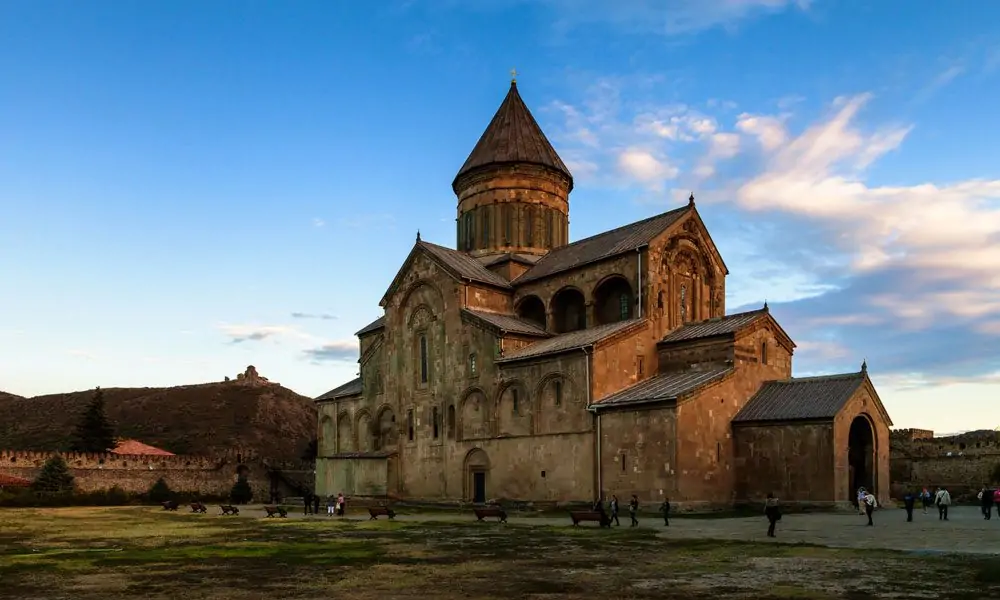
Svetitskhoveli Cathedral is the reason most people come. Built in the 11th century over a site where Christ’s robe is said to be buried, it is one of the most important religious buildings in the Caucasus and still functions as a working cathedral. On the hill above the town, Jvari Monastery looks out over the confluence of the Mtkvari and Aragvi rivers, where the two waters meet in visibly different colors. That view has been painted, photographed, and written about for centuries.
Half a day is enough, and it combines naturally with the drive north toward Kazbegi.
Kazbegi, officially Stepantsminda, is a mountain town at 1,740 meters in the Greater Caucasus, about two and a half hours from Tbilisi by road.
The view that defines Georgia in most travel photography is here: Gergeti Trinity Church at 2,170 meters, standing alone on a ridge above the town with the snow on Mount Kazbek rising behind it. It is the most photographed place in Georgia, and it holds up in person.
The drive is worth as much as the destination. The Georgian Military Highway climbs past the medieval Ananuri fortress above the turquoise Zhinvali reservoir, through the ski resort at Gudauri, and over the Jvari Pass at 2,379 meters before dropping into the Kazbegi valley.
Treat it as a one- or two-night stay rather than a day trip. The mountains often sit under cloud in the afternoon and clear overnight, so the morning light is the reason to stay.
Cascade Travel includes Kazbegi as an optional addition to Georgia itineraries with enough time for an overnight stay in the mountains.
Kakheti is eastern Georgia’s wine heartland: the broad floor of the Alazani Valley, the wall of the Caucasus along its northern edge, and a mix of large commercial wineries and small family producers still fermenting in clay qvevri buried in the ground. Wine tastings, cellar visits, village meals, and monastery stops make Kakheti one of the easiest regions to include when looking for things to do in the country of Georgia rather than simply places to photograph.
Telavi is the practical base, a working regional town with enough good accommodation to anchor two or three nights. Sighnaghi is the most visited stop, a small town perched above the valley inside an almost complete medieval wall, though it has grown noticeably more touristy in recent years. At the eastern end of the valley, Kvareli is worth the drive for the Khareba Winery tunnels, kilometers of cellars cut into the mountainside at a constant natural temperature.
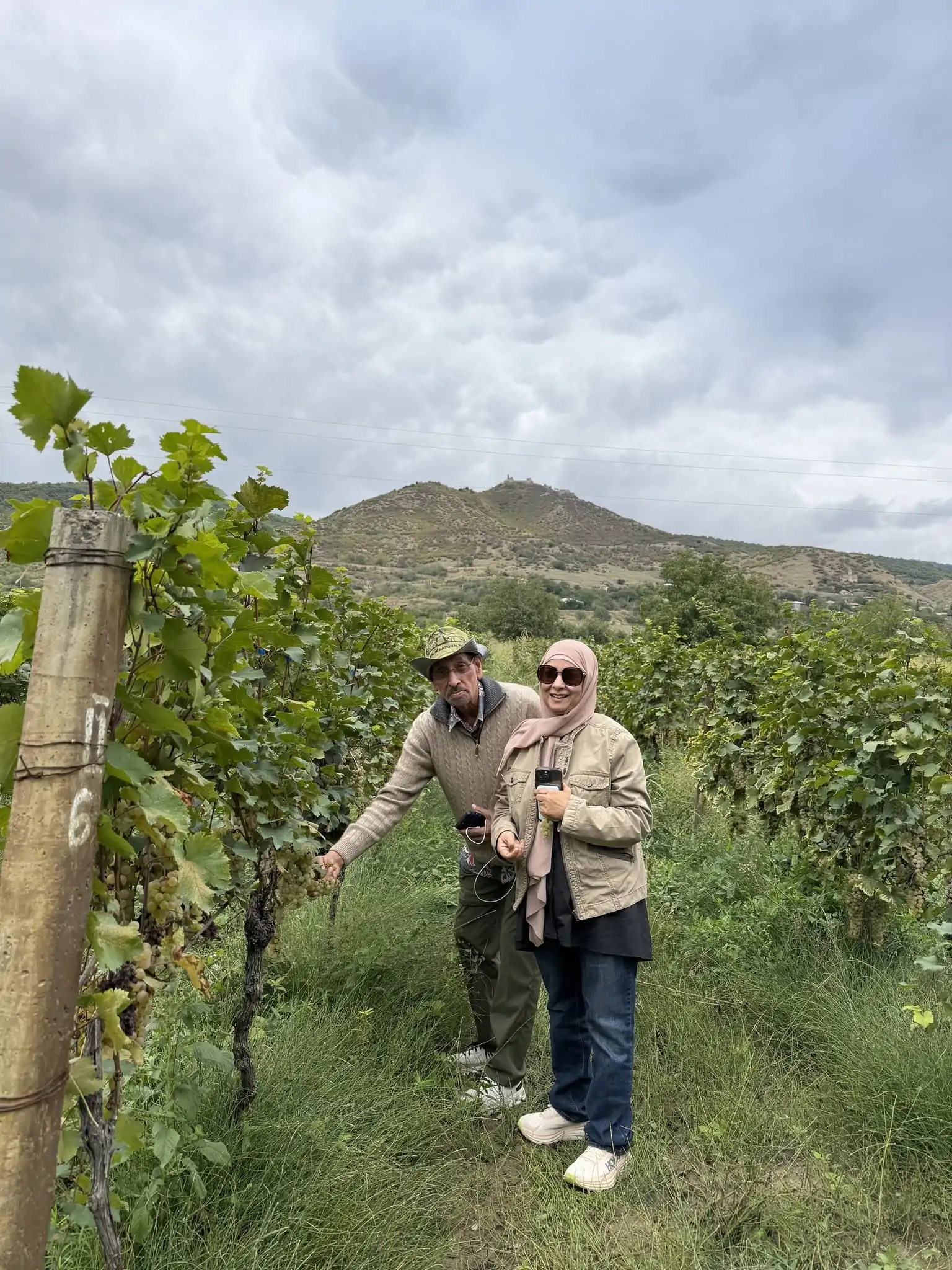
The site that tends to stay with people, though, is Alaverdi Monastery, a 6th-century cathedral standing alone in the vineyards with the mountains behind it.
Cascade Travel’s blog has a dedicated Kakheti guide if you want more depth on specific wineries and routes.
South and west of Tbilisi, the Samtskhe-Javakheti region gets skipped on shorter itineraries, which is exactly why it rewards travelers with more time. It holds Georgia’s best-known spa town, one of its largest national parks, and a cave city that ranks among the most extraordinary historical sites in the wider Caucasus. Two days cover the region comfortably as a loop from Tbilisi.
Borjomi is a 19th-century resort town set in a forested gorge, built around naturally carbonated mineral springs. Borjomi water is Georgia’s most recognized export after wine, and you can drink it warm from the source in a small public park in the center of town, where it tastes considerably more mineral than the bottled version. The Borjomi-Kharagauli National Park surrounding the town is one of the largest protected forest areas in the Caucasus, with marked routes ranging from short walks to multi-day traverses. Borjomi works well as an overnight stop between Tbilisi and the cave towns further south.
Vardzia is a 12th-century cave monastery city carved into a volcanic cliff above the Mtkvari River in southern Samtskhe-Javakheti. Queen Tamar ordered its construction as both a monastery and a defensive refuge against invasion from the south. At its height, it held more than 3,000 rooms across 13 levels, along with a church, a wine cellar, a pharmacy and a throne room, all cut directly into the rock and invisible from the valley floor. An earthquake in 1283 sheared away the outer cliff face and exposed the interior, which is how it appears today: a honeycomb of open chambers stacked up the rock wall. The frescoes in the Church of the Dormition survive, including a portrait of Queen Tamar painted in her lifetime. It sits about three and a half hours from Tbilisi and pairs naturally with Borjomi and the restored 9th-century Rabati Castle in Akhaltsikhe as a two-day southern loop. For its scale and significance, it sees remarkably few visitors.
Our luxury Georgia tour includes Vardzia after an overnight stay in Borjomi, as part of an 11-day route that also covers Kakheti, Kazbegi, and Kutaisi.
Kutaisi is Georgia’s second city, more lived-in and less polished than Tbilisi, with a busy covered market that is one of the better places in the country to understand how Georgians actually eat. Just outside town, Gelati Monastery is a UNESCO World Heritage site and one of the most important medieval monastic complexes in Georgia, founded by King David the Builder in 1106 and once a functioning academy. Kutaisi also has an international airport, which makes it a practical entry or exit point rather than flying in and out of Tbilisi twice.
The wider west includes Imereti wine country, where the winemaking style differs from Kakheti in ways that are obvious in the glass, and the Racha mountains for quieter hiking. On the coast, Batumi is a Black Sea resort city with a long seaside boulevard, an unrestrained skyline of modern towers, and the region’s Adjarian khachapuri, a boat of bread filled with cheese and a raw egg stirred in at the table. Worth knowing about, though a lower priority than Tbilisi, Kakheti or Kazbegi on a first trip.
Svaneti is the most dramatic region in the country and the most demanding to reach, a high valley system in the northwest where medieval defensive towers still stand in villages beneath 4,000 and 5,000 meter peaks. It suits travelers with ten to fourteen days who specifically want mountain culture and are comfortable with long transfers and rough roads. On a shorter trip, Kazbegi gives you the Caucasus with a fraction of the effort.
Mestia is the main town of Svaneti and the practical base for the region. It sits at around 1,500 meters, ringed by peaks well above 4,000. The town is defined by its Svan towers, squat medieval stone structures built by individual families for defense against raids and blood feuds, many of them still standing between the houses. The Svaneti Museum of History and Ethnography holds a serious collection of medieval icons, illuminated manuscripts and worked gold recovered from village churches across the valleys; much of it survived precisely because the region was too remote to conquer. Infrastructure has improved considerably: there is a small airport with flights from Tbilisi, a handful of genuinely good guesthouses, and marked trails running into the surrounding valleys.
Ushguli is a cluster of four villages at 2,200 meters, widely cited as one of the highest permanently inhabited settlements in Europe and a UNESCO World Heritage site. The Svan towers here are the best preserved anywhere in the region, standing in a landscape of glaciers and high summer meadows with Shkhara, at 5,193 meters, filling the head of the valley. Getting there from Mestia means either a full day on foot or a slow drive by 4WD on an unpaved mountain road, and the route is usually closed by snow from late autumn into spring. For anyone who has come as far as Svaneti, it is worth the day. It is not something to attempt from Tbilisi.
The regions connect logically once you see them on a map, and most itineraries build outward from Tbilisi. The main places to see in Georgia are spread across several directions from the capital, so the number of days you have matters more than trying to cover as much ground as possible.
Seven days covers Tbilisi, Mtskheta, Kakheti, and one mountain stop, either Kazbegi in the north or the Borjomi and Vardzia loop in the south. Ten to twelve days lets you take both, or add western Georgia and Kutaisi, or simply slow down in Kakheti. Two weeks is what Svaneti realistically requires on top of the rest.
There is also a strong case for pairing Georgia with Armenia. The two countries sit side by side and complement each other well, Georgia leaning toward mountains, wine and imperial history, Armenia toward early Christian architecture and high volcanic plateau.
Browse Georgia tours to see how Cascade Travel structures 7 to 14-day itineraries across the country’s main regions. Travelers combining the two can browse Caucasus tours for two-country itineraries with local guides and border logistics handled throughout.
Georgia is one of those countries where the more time you give it, the more it returns. Tbilisi and Svaneti feel like different worlds, and Kakheti and Kazbegi ask for entirely different pacing. A week covers the highlights. Two weeks start to feel like you know the place.